Frank Romero (b.1941, Los Angeles, CA) is among the most influential pioneers of the Chicano Art Movement. Romero employs various media—including painting, neon, sculpture, and murals—to explore narratives related to the Chicanx experience, Latin American heritage, and American Pop culture. His visual explorations of Chicanidad (Chicanx identity) stand as cornerstones of this period that arose from El Movimiento, the Mexican American social and political civil rights movement that began in the early 1970s. Pulling together a diverse cast of signs and symbols to invent a visual language reflective of the multiculturalism at the core of the Chicanx community, Romero’s works provide insight into his life as both an artist and a Mexican American from East LA. Romero has spent his life traveling, living, and working between Los Angeles, New York, New Mexico, and France, which has expanded his ideas of identity and Chicanidad beyond urban settings or the complexities of a single city.
Canonical to the history of Chicano Art, Romero not only helped create the mold that came to define it, but also continues to push its bounds. As a member of the 1970s Chicano art collective Los Four, Romero and fellow artists Carlos Almaraz, Beto de la Rocha, and Gilbert “Magu” Luján helped define and promote Mexican American awareness through their individual and collaborative artworks, murals, publications, and exhibitions. Los Four's historic 1974 exhibition at the Los Angeles County Museum of Art (LACMA) was the country's first presentation of Chicano art at a major art institution. This watershed exhibition, and its accompanying programming, challenged how we define both Chicano art and fine art more broadly—a postcolonial intervention that exposed exclusionary legacies and opened doors for future generations of artists. Since then, Romero has exhibited extensively in the United States, Europe, and Japan, with his work being included in notable exhibitions such as Our America: The Latino Presence in American Art, organized by the Smithsonian American Art Museum, Washington, D.C.; Chicano Art: Resistance and Affirmation, 1965-1985, organized by the Wight Art Gallery at the University of California, Los Angeles and the CARA National Advisory Committee, Los Angeles, CA; and Hispanic Art in the United States: Thirty Contemporary Painters and Sculptors, organized by the Museum of Fine Arts Houston, Houston, TX, and the Corcoran Gallery, Washington, D.C.
Romero’s works are included in such prominent collections as the Smithsonian American Art Museum, Washington, D.C.; Whitney Museum of American Art, New York, NY; Museum of Modern Art Library, New York, NY; The Los Angeles County Museum of Art (LACMA), Los Angeles, CA; The Cheech Marin Center for Chicano Art & Culture, Riverside, CA; The Crocker Art Museum, Sacramento, CA; Museum of Contemporary Art San Diego, San Diego, CA; The Carnegie Art Museum, Oxnard, CA; the Blanton Museum of Art, Austin, TX; the McNay Art Museum, San Antonio, TX, among others.
Frank Romero
Saucers Seen Over Hollywood, 2025
Acrylic on canvas
72 x 96 in (182.9 x 243.8 cm)
Frank Romero
Flying Saucers over Tucumcari, 2025
Acrylic on canvas
72 x 84 in (182.9 x 213.4 cm)
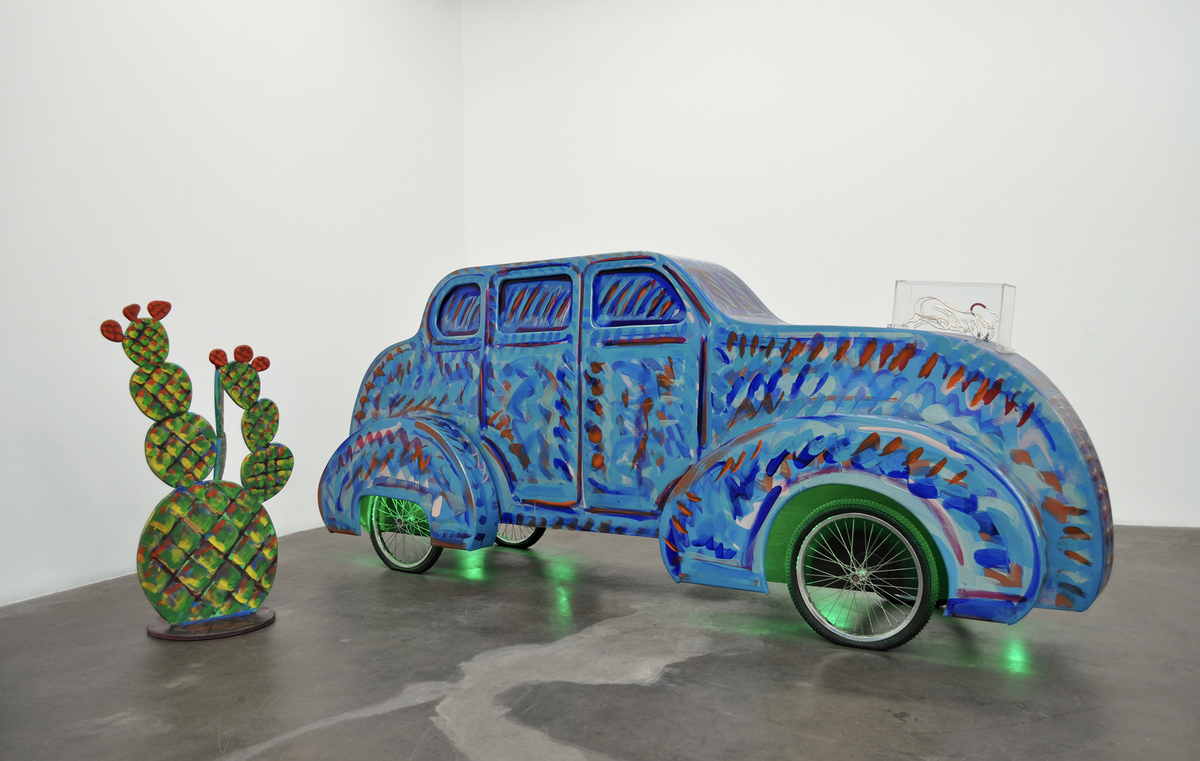
Frank Romero
L.A. Lowrider, 1991-2025
Acrylic and neon on wood
132 x 29 x 55 in (335.3 x 73.7 x 139.7 cm)
Frank Romero
Western Hat, Baul y Pistola, 2025
Acrylic on canvas
48 x 72 in (121.9 x 182.9 cm)
Frank Romero
Cowboy Boots y Pistola de Oro, 2025
Acrylic on canvas
20 x 16 in (50.8 x 40.6 cm)
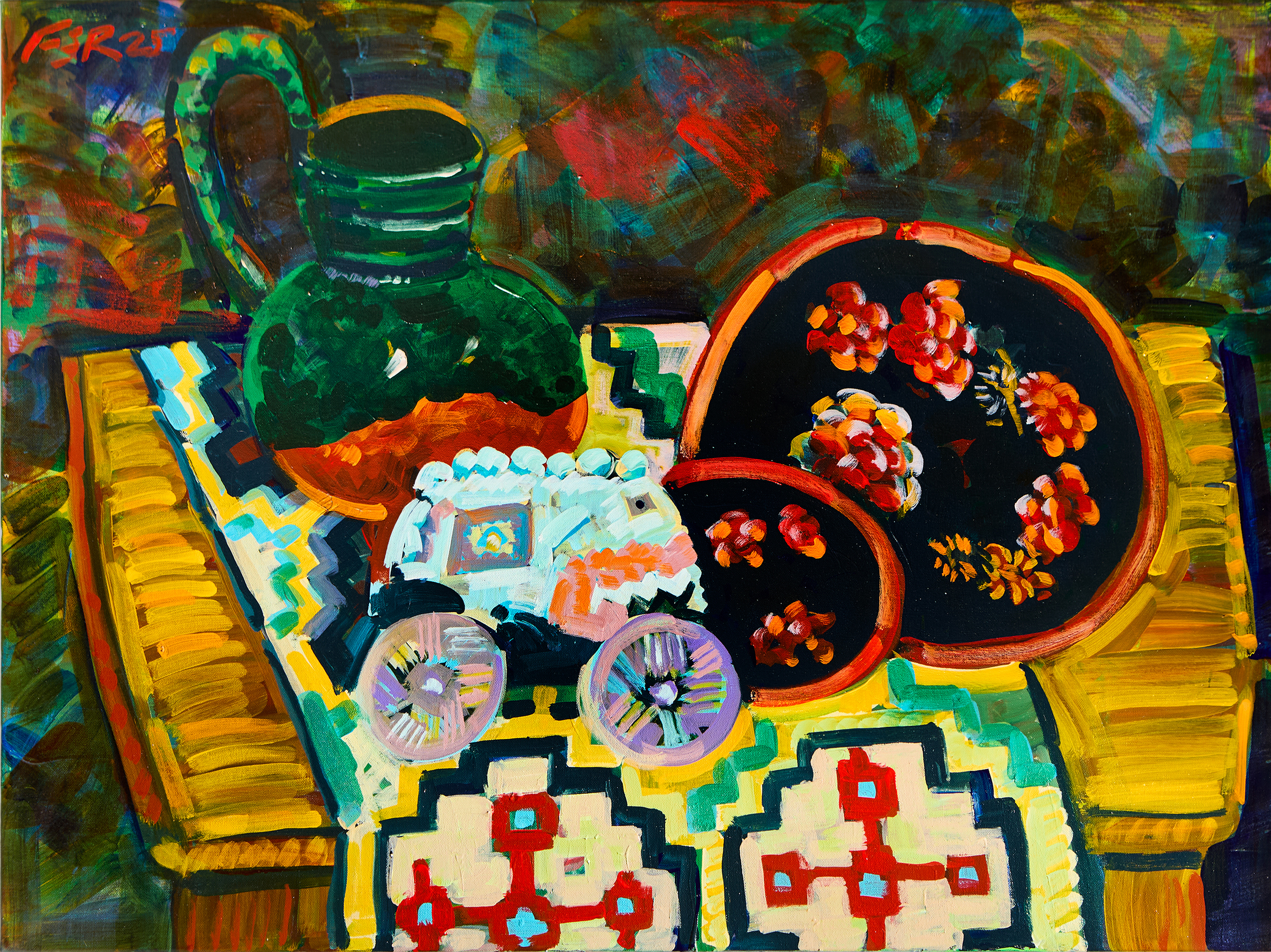
Frank Romero
Pingo, Olinada y Atzompa, 2025
Acrylic on canvas
30 x 40 in (76.2 x 101.6 cm)
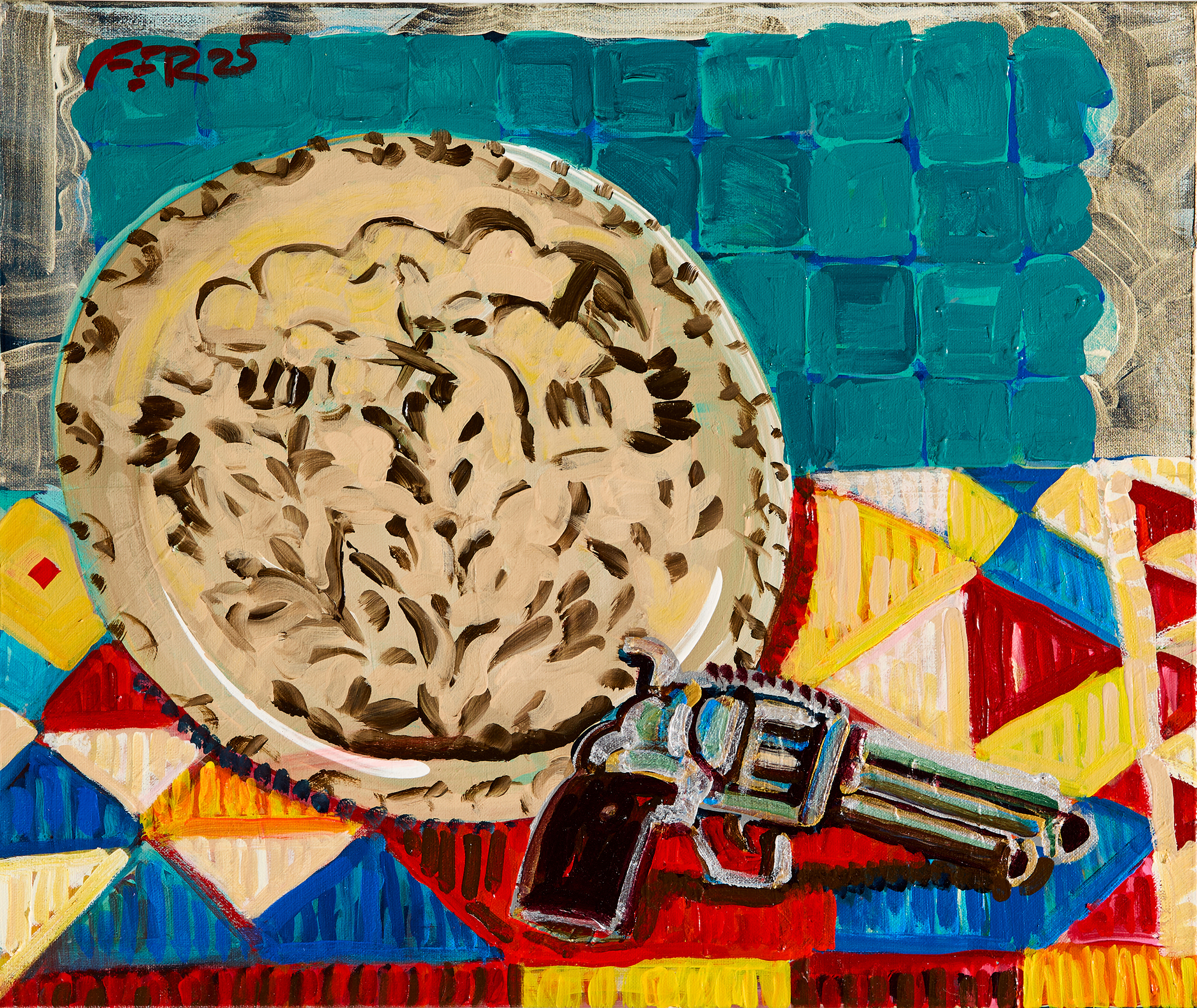
Frank Romero
Six Gun and Mexican Platter, 2025
Acrylic on canvas
24 x 20 in (61 x 50.8 cm)
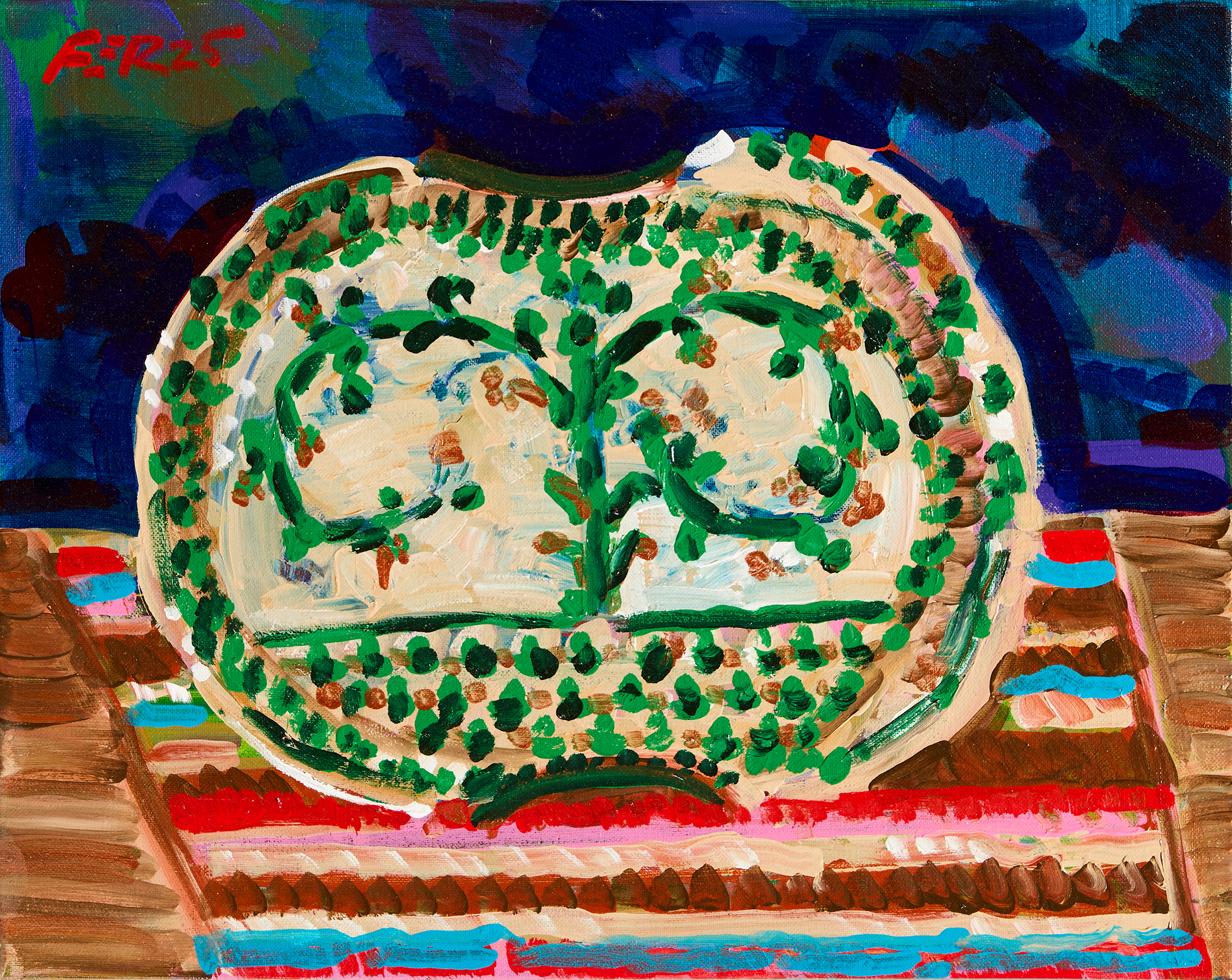
Frank Romero
Guanajuato Batea 5, 2025
Acrylic on canvas
16 x 20 in (40.6 x 50.8 cm)
By Matt Stromberg
California Dreaming presents new work by pioneering Chicano artist Frank Romero alongside a selection of iconic older works from his six-decade career. The exhibition includes paintings as well as wood and neon sculptures that portray quintessentially LA elements he returns to again and again: freeways and landmarks, palm trees, cacti and other desert flora and fauna, and the ubiquitous automobile. Into these scenes, he has added a new motif: flying saucers, which signify both a Hollywood nostalgia and an allusion to rising xenophobia. These works are accompanied by new still-lifes of objects Romero has gathered on his travels, highlighting the rich cultural nexus he pulls from.
By Paula Mejía
In Frank Romero’s six decades-plus of professional artmaking, the sweeping environs that distinguish LA from any other city in the world have become familiar visual motifs. Romero uses the city as a lens in his art, training it onto specific inflection points to pluck out themes of deep cultural and historical gravitas. Another exhibition mounted simultaneously in the gallery — Karla Diaz’s Mal de Ojo — feels spiritually in conversation with Romero’s art, particularly where themes of surveillance are concerned. In them, she wonders what the malevolent eye might see if it were focused not on the individual but rather on the collective, a mechanism for shielding one another from harm.
By Staff
“Mal de Ojo” presents a series of self-portraits that delve into the many facets of Diaz’ identity, from familial bonds and cultural heritage to her alter egos, and with them, her fears, hopes and dreams. “California Dreaming” invites viewers to a nighttime drive — from the glimmering boulevards of Hollywood to the vast openness of the Sonoran Desert. The UFOs, soaring from Hollywood to Roswell, are nostalgic and futuristic, nodding to vintage Hollywood props and holding a cheeky resemblance to sombreros. They hold space for humor, social critique and the complex emotional layers of collective memory and Chicanx experience.
By William Moreno
Veteran artist Frank Romero and GenX Karla Diaz have mounted exuberant, color-drenched spectacles with concurrent exhibitions at downtown Los Angeles’ Luis De Jesus Gallery – and their intentions and resultant imagery couldn’t be more disparate. Each is titled separately - Romero’s “California Dreaming,” taking cues from a classic, upbeat Mama’s and Papa’s song and Diaz’s “Mal de Ojo” or evil eye, proffering an ancient talisman known alternately as a curse or protector.
By Booth Moore
Frank Romero Returns With Timely New Paintings: Back in L.A., a Chicano art movement pioneer returns to the gallery scene Sept. 13 with “Frank Romero: California Dreaming,” a solo exhibition of new paintings and seminal works from the artist’s six-decade career, including neon nightscapes dotted with symbols of the city’s golden age of cinema.
By Shana Nys Dambrot and HIJINX ARTS
Frank Romero California Dreaming and Karla Diaz: Mal de Ojo open September 13, 4-7pm at Luis De Jesus Los Angeles. Romero cruises through LA’s mythic and geographic landscapes in new paintings and neon sculptures that merge desert iconography, classic car culture motifs, and surrealist dream logic. His hyper-chromatic hillsides, ubiquitous UFOs, and cheeky cowboy boots compose a kind of Chicano experience that feels both nostalgic and future-forward. Diaz turns inward with emotional self-portraits that place folklore and personal history in vivid dialogue. In watercolors and ink on paper, she reworks cultural symbolism—Frida Kahlo riffs, cactus ears, protective talismans, political emblems—to move through vulnerability, vision, and resilience.
By Katerina Portela
Frank Romero, “California Dreaming”
The skies are awash in purple and illuminated by the eerie glow of UFOs. Lowriders drive through surreal desert landscapes and open their doors to you. Such is the journey of Frank Romero’s new exhibition, “California Dreaming,” at contemporary art gallery Luis De Jesus Los Angeles. Exploring California and beyond through the lens of sci-fi dreamscapes, the show depicts familiar Western fixtures of palm trees, cacti, the Chinese Theater and vintage cars, highlighting Mexican-Californian identity and West Coast memories. Open from Sept. 13 to Oct. 25. luisdejesus.com
By Nicholas Frank
Writing in the catalogue produced for the two-part survey De Aquí Y De Allá: Frank Romero, A Survey at Ruiz-Healy Art locations in San Antonio and New York, curator Rafael Barrientos Martínez drew a throughline between ancient Indigenous pictographs of the Southwest and Romero’s graffiti-based symbology. The exhibition itself draws a line from Romero’s standout 1981 mural-sized painting Por El Pueblo through the present, with recent examples of the 83-year-old painter’s work, including a recent refashioning of works from The Adobe Series of 1995 and the Nopal table sculptures of 2024.
By Christopher Karr
You never know what to expect from a Frank Romero exhibit. As a frequent visitor to San Antonio’s diferent galleries and museums, I was intrigued by what his solo show would bring to the city. The Los Angeles-based artist is one of the pioneers of the Chicano Art Movement. He is most known for his paintings and mural work that draws upon the intricacies of Chicano cultural narratives in Los Angeles and beyond. De aquí y de allá: Frank Romero, A Survey is a solo exhibition of works by Romero, curated by Rafael Barrientos Martínez, a doctoral candidate in art history at the University of California, Los Angeles (UCLA). I look at the show through the lens of Romero’s vivid symbolism and the elements within De aquí y de allá that refer to a transnational Chicano experience.
By Maximilíano Durón
Chicano artist Frank Romero was born in 1941 in East Los Angeles and grew up in the culturally mixed, middle-class community of Boyle Heights. Bold, colorful, and energetic scenes of daily life in Los Angeles characterize Romero’s paintings, which feature iconic images like lowriders, palm trees, and freeways. Romero’s paintings mix elements of pop art with traditional Mexican and Chicano motifs to produce unique visual experiences.
By Eva Recinos
There's a clip from a documentary of artist collective Los Four that has become iconic, in a way: it shows the four artists sitting around a table talking loudly while taking notes. Carlos Almaraz, Gilbert Magu Luján, Frank Romero and Robert "Beto" de La Rocha are talking shop, their voices sometimes rising. Almaraz and Romero lived together in that space for about 10 years. It became the meeting space for the group, a collective of four artists with different aesthetics but similar missions.
By Douglas Messerli
The new retrospective of Chicano artist Frank Romero at the Museum of Latin American Art in Long Beach (MOLAA), Dreamland, comes at an auspicious time. One of the original Los Four, along with Carlos Almaraz (1941– 1989), Roberto de la Rocha (b. 1937) and Gilbert Luján (1940–2011) (later transforming into Los Five when they included Judithe Hernández [b. 1948]), Romero (b. 1941) helped to solidify the reputations of Chicano American artists in Los Angeles and across the country. Along with another Angelino group, ASCO (Willie Herron, Harry Gamboa, Jr., Gronk, and Patssi Valdez), Romero and the Los Four put Chicano art permanently on the map.
By Carolina A. Miranda
From the outside, the red warehouse on West Avenue 34 in Lincoln Heights looks like every other industrial building on the block — the sort of place that might deliver drilling and clanging. But slip past the front door and you are greeted by a wonderland of art.
Bright canvases are arrayed around the space in various stages of completion. Ceramic dog creatures peer out from vitrines. A neon sign dangles from the rafters, illuminating the words “Car Radio” and a stylized bolt of lightning — a ray of energy that seems to infuse the room with a crackle.